
It's official: I'm a huge fan of the Danish publisher People'sPress. Not only do they publish one of my favorite writers, Sara Blaedel, but they also gave me such a warm welcome when I arrived at Krimimessen Horsens in Denmark, and even invited me to a special breakfast for bloggers to get to know Danish crime writers!
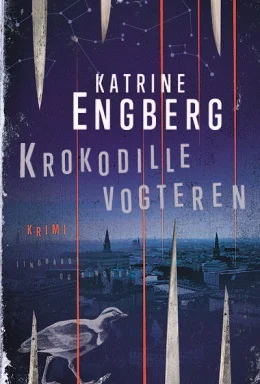
This breakfast was so much fun, and perhaps even more importantly, it introduced me to a new author who will be at the very top of my list of authors to watch—Danish crime writer Katrine Engberg. Katrine's debut, THE COURSER, has already garnered major attention in Denmark and Europe, and I'm going to be counting down the days until it finds a US publisher! It sounds like an excellent read, and it's already received fantastic reviews and a blurb from Sara Blaedel! You can find plot details for Katrine's book and her author bio at the bottom of this post.
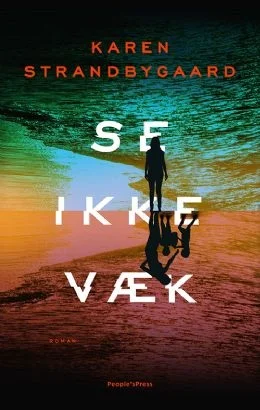
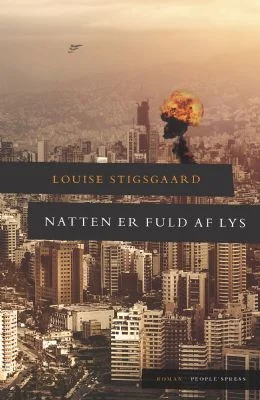
Also in attendance at the breakfast were crime writers Louise Stigsgaard and Karen Strandbygaard! It was an absolute pleasure to meet these authors and learn a bit about their books and writing processes. I also want to note that everyone at this breakfast was so wonderfully generous to make sure I always knew what was going on, even though the breakfast was originally meant to be all in Danish! Huge thank you to the authors and organizers for their thoughtfulness.
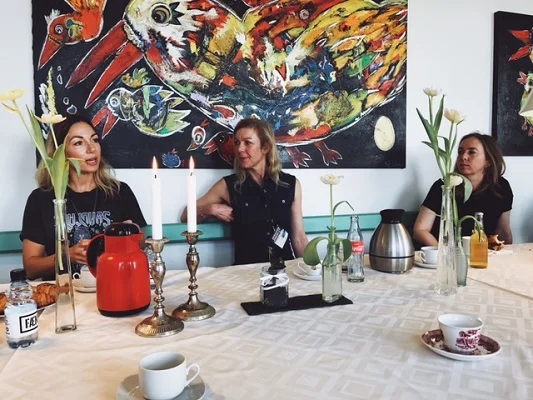
Katrine Engberg, Louis Stigsgaard, and Karen Strandbygaard
People'sPress Crime Breakfast
Two topics discussed in the breakfast were particularly interesting to me. The authors discussed both the pro’s and con’s of early reader feedback, and whether or not they read other crime books while they’re in the middle of writing one!
Topic 1: How do the authors feel about getting early reader feedback? Is this part of their writing process?
Katrine actually handed over her unfinished manuscript to readers for feedback! In Denmark, there's a huge book club with thousands of readers in it, and Katrine and her publisher chose 10 readers from this massive book club to have a copy of her unfinished manuscript for a week. At the end of the week, Katrine met with each reader individually to discuss their feedback! Katrine explained that she comes from the world of TV and theater (her background is as a dancer and choreographer), and in this world, this kind of feedback is an essential part of the creative process. Because of her background, this format of getting early reader feedback really worked for Katrine. She found it very motivating, and it also helped her see issues that she had become blind to, because she was too close to the work to notice them herself. She noted that in any creative work, whether it's theater or writing or anything in between, you can easily become too close to what you're doing and become blind to its flaws, and that's when getting an outside perspective is crucial.
Louise is in the practice of sharing her manuscript with friends and colleagues, both in and out of the writing profession. She has actually found that readers who are not coming from a writing background can often give the most useful feedback—they're not looking at it from a literary perspective, they're looking at it as a reader. Their feedback is hands-on, constructive, and straightforward, and Louise finds it invaluable to her writing process.
Karen takes a different approach to early feedback: she belongs to a group of writers who read each other's work and give one another feedback. Karen feels that you have to have other people reading your material, and you need to be reading other's work as well—it's the only way you can learn and grow as an author.
Topic 2: Do the authors read other crime books while writing crime fiction themselves?
The next question raised was a totally fascinating one! Someone in the group mentioned how Jussi Adler-Olsen is said to not read other crime books while writing, because he's concerned he will inadvertently be inspired by the book he's reading, and incorporate themes or styles from it into his own writing. The question raised to the authors was: do you read other crime books? Or are you concerned that if you do, you'll subconsciously mimic that book in your own writing?
Karen shared that she reads whatever she can get her hands on. Lately, she's been focusing on reading a lot of American authors, particularly authors of domestic thrillers. Her editor has told her that her books actually fit better into that sub genre of crime fiction, so now she wants to see what the genre is all about! That being said, Karen noted that she definitely feels it's crucial to define your own voice as a writer—if you let yourself start to imitate the books you're reading, what you're writing won't be any good, because it isn't your original voice.
Louise feels more in line with Jussi's approach to writing. She has the same concern—she feels that if you love a crime novel, you can love it so much that without even noticing, it can start to influence your own work. Not because you mean to copy or imitate someone else's writing, but just because you love it so much and your brain is so steeped in that book's world that it can have an influence on your own work.
Katrine was in agreement with Louise. She felt that it's really true—you can be influenced by everything around you without noticing. When she's writing the first draft of her books, she doesn't read anything else to prevent this exact thing from happening. At first, when she started writing, she was reading Donna Tartt at the same time, and she noticed that her writing became more and more like Tartt's—with very long, descriptive sentences. But Katrine said that during this phase, her writing was truly boring, because it just doesn't work to write like someone else! You have to stay away from writing in a voice that isn't your own—it's all about finding your own voice, and then your story will click.
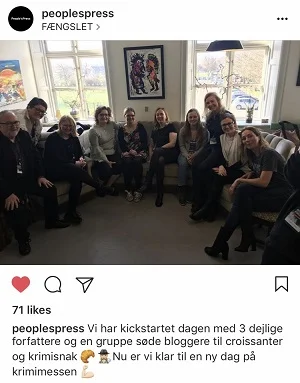
I had such a great time at this breakfast! The authors gave such great bits of insight into their writing processes, and it was a great setting in which to meet them and learn a little bit about them. Along with meeting these fantastic authors, I also got to meet a number of Danish bloggers, which was an added bonus. I was blown away by how welcoming the authors, organizers, and bloggers were—I felt right at home, and truly appreciated their kindness. Thank you so much to People’sPress for inviting me to this event!
Last but certainly not least: as promised, below you'll find more information about Katrine Engberg - remember her name, I expect you'll be hearing all about her here in the US soon!
Plus, as a bonus: you can read about Karen Strandbygaard's domestic thriller in English here!
Learn More: Katrine Engberg
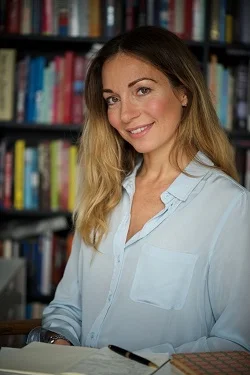
Photo credit: Timm Vladimir
Author Bio:
Katrine Engberg (b. 1975) had already attained the status of acclaimed dancer and choreographer when she made her writer’s debut as a non-fiction author in 2006. Engberg has continued to contribute to the Arts since, both as a director and a choreographer, working within television and theatre. Her authorship has likewise blossomed into one full of sensitive portrayals and ingeniously intertwined plot threads. The Courser is Katrine Engberg’s first crime fiction novel, and the start of a new series hailed for its artful originality.
About THE COURSER:
A young woman is discovered brutally murdered in her home, a pattern carved into her face. Police Sergeants Jeppe Kørner and Anette Werner of the Copenhagen Police are assigned to the case. A link is quickly established between the murder victim – Julie Stender – and her landlady, Esther de Laurenti. Seeing in Julie a shade of her own carefully hidden past, the older woman has used Julie as a character in her still unfinished mystery novel. Something that resulted in the young woman’s death both on and off paper.
But when the evidence points to Esther being the focus of a game of vengeance rather than their killer, Police Sergeants Jeppe and Anette must go back into the two womens’ pasts to uncover the secret that made them targets of not only a killer bent on revenge, but the puppet-master who has been pulling his strings all along.
Katrine Engberg’s debut novel The Courser is a finely wrought work of chilling suspense, full of sinister twists and sensitively portrayed human fates. The novel is the first in a trilogy featuring the Police Sergeants Jeppe Kørner and Anette Werner.
To learn more about Katrine and read an English sample of THE COURSER, visit her agent's website: http://www.salomonssonagency.se/books/krokodillevogteren.